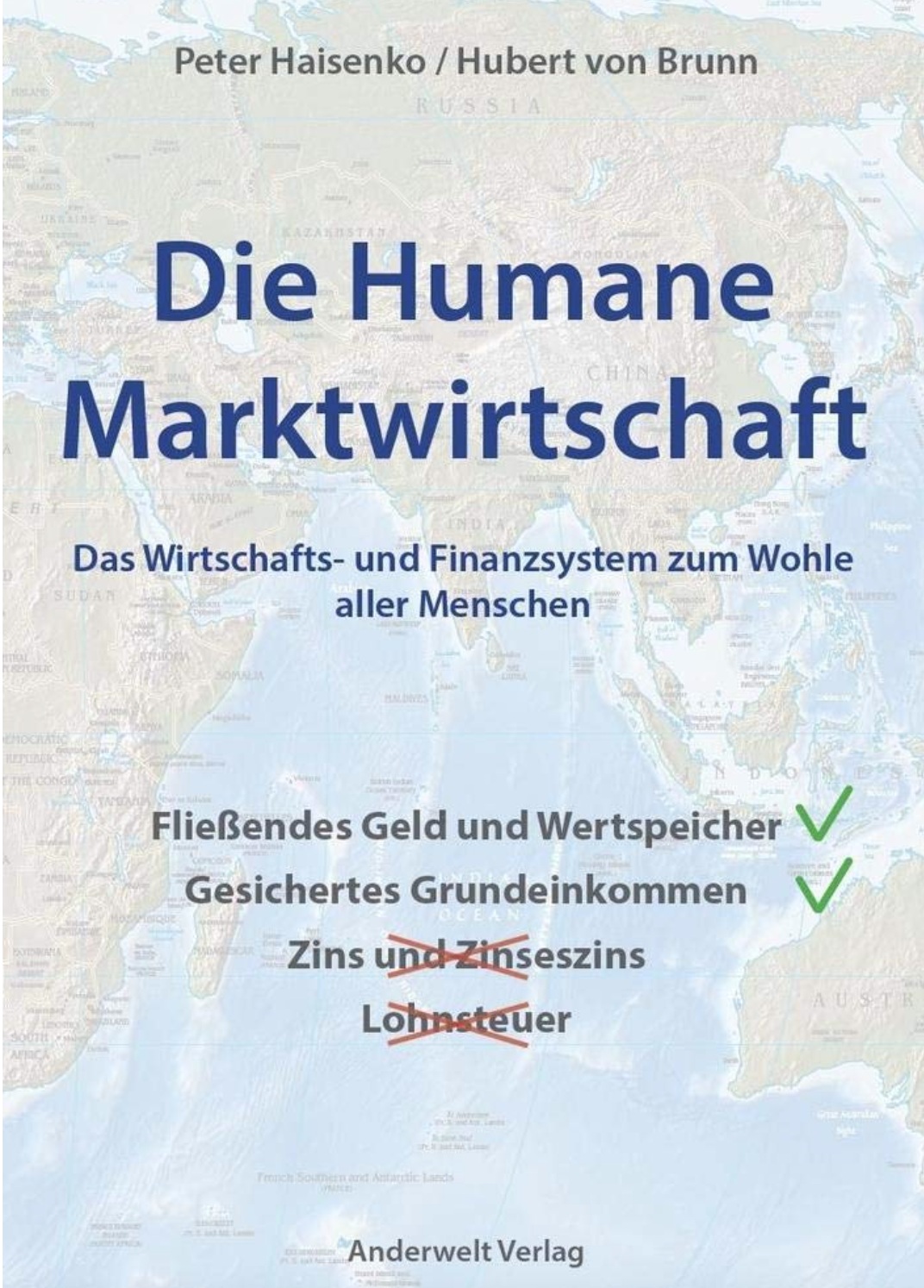
The Humane Market Economy is a monetary and economic model in which money is, in principle, provided once and debt-free instead of being created over and over through interest-bearing credit. Interest remains only as a uniform, stable loan rate without compound interest, savings interest and liquidity premium (see the section "Interest in the Humane Market Economy"). This page presents the concept by Peter Haisenko and Hubert von Brunn and its extension for the euro area in detail – with a video presentation, key aspects and an honest assessment of its limits.
Real-economy-based ·
Interest-/Debt-free ·
Circular ·
Humane
💧 Flowing money in the Humane Market Economy Core element
Circulation-secured (“flowing”) money after Silvio Gesell is a load-bearing building block: balances above €5,000 can voluntarily go into the
value store (value preservation without return; the value store is circulation-secured and levy-based), otherwise a
decay discount applies. Holding money back thus brings no advantage any more, wealth does not grow simply through
holding money, and the money stays in the cycle. In this page's view flowing money is what must remain relevant for the future against hoarding,
wealth concentration and a stagnating economy – apart from the
Natural Economic Order (INWO) none of the comprehensive concepts compared on this page has it in its programme (regional currencies such as the Chiemgauer use circulation security on a small scale).
→ Why flowing money stays relevant (incl. company shares)
🎓 The Authors
💡
Peter Haisenko, born 1952 in Munich, spent 30 years as an
international airline pilot before turning to writing and journalism on
economics and contemporary history from 2004 onward. In 2007 he founded
Anderwelt Verlag, and in 2013 the online magazine
Anderweltonline.com.
✍️
Hubert von Brunn is a writer, columnist and coach.
Studied Germanism, Amerikanism, Philosophy.
After working as an editor, chief reporter and editor-in-chief at daily newspapers,
he has worked independently as an author since the early 1990s.
🧩
Gabriel Waldeyer is the author of the
HME extension "RICH" which takes care of the implementation in the EURO zone and describes himself:
SAP Finance Freelancer ·
Monetary & Economic Reform Integrator ·
Navigating Collective, Individual & Systemic Needs ·
Common thread: integrative systems thinking, clarity, depth, precision, staying power.
Gabriel Waldeyer (Homepage).
📘 Online version of the book – free download
📖 The theoretical foundation of the Humane Market Economy – the complete book –
is available as a free PDF download.
⏱ The Humane Market Economy in 3 Minutes – Overview
The five building blocks of the Humane Market Economy at a glance – the PDF below shows the complete overview on one page, the book the details.
💰 1. The Monetative
Money serves the real economy – government budgets without debt.
The Monetative organises a pay-as-you-go, circulation-secured store of value. Current-account money serves payments. Balances above €5,000 may be voluntarily transferred to the store of value as certificates backed by the real economy; otherwise, a depreciation charge applies.
Sources of funds: provision · provisions · equity · reinvestment · savings · trade surpluses
Uses of funds: lending · public projects/investment · retirement provision · pensions · drawdown of savings · trade deficits
Value stability – including asset values: no debt-driven logic · no compound interest · no Cantillon effect · no private money creation · no monetary hoarding · no uncovered bank deposits
🏭 2. Performance · Entrepreneurship · State
Productive performance and value creation become the primary sources of income.
100% of employment income remains available. Reinvested profits strengthen businesses, innovation and employment. The pressure for continuous growth disappears – durable, repairable and resource-efficient products become economically attractive.
Public administration is financed by taxing unearned income and non-reinvested profits – including asset income, rents and leases, and assets acquired without personal productive contribution and subsequently monetised.
🏦 3. Credit · Investment · Innovation
A simple, uniform and permanently stable interest rate for all.
Investment loans approx. 3% · consumer loans approx. 12%
Banks intermediate store-of-value capital as loans.
Capital → businesses · machinery · innovation · real value creation
👨👩👧👦 4. Basic Security · Healthcare · Retirement
Basic security and provision for the future are permanently secured.
Consumption surcharge approx. 20–30% → basic security · healthcare · long-term care
Store of value → retirement provision and pensions · Monetative interest income → social fund
🌍 5. World Currency Order · Trade · Stock Exchanges
Stable purchasing power through real values and international balance.
Fair exchange rates · balancing trade surpluses/deficits · real-value orientation
Capital for value creation rather than speculation: derivatives · commodity futures · warrants are not part of the system.
Stock exchanges for company shares remain, but become less important as speculative and capital-raising motives are structurally reduced.
Foundations for peace: basic security · prosperity · stable currency · fair trade · performance-based fairness · economic balance.
💶 Interest in the Humane Market Economy: Not Abolished but Repurposed
The Humane Market Economy abolishes compound interest, savings interest and the liquidity premium – but not interest as such. What remains is one uniform, permanently stable interest rate on loans only.
🧾
What falls away: Interest on deposits (savings interest), the compound-interest effect, the liquidity-premium share in interest (the reward for not spending money) and private money creation through interest-bearing credit.
🏦
Where the interest comes from: It is not privately created but comes from the common value store of the Monetative; banks intermediate its capital as loans. Interest income flows into the Monetative (social fund), not to private creditors.
🛡
Character: default-risk fee. The interest covers the default risk of loans and is no return for owning money.
🧠
Psychological signal: A noticeable, uniform rate is an essential incentive to actually repay a loan and not to refinance constantly, as is common today.
🔄
Saving incentive and inflow into the value store: Only if borrowed money is more expensive than saved money does the impulse to save remain. This keeps the inflow channel into the value store steadily flowing – and the loans, in turn, are fed from this value store. This is the reason for a, if simple, rate on loans.
Interest in HME/RICH compared with INWO (Freigeld and Freiboden after Gesell)
| Topic | INWO: Freigeld and Freiboden (Gesell et al.) | Humane Market Economy / RICH | Assessment 🟣 |
|---|
| Interest on loans | Through Freigeld, interest is meant to sink towards zero as the liquidity premium falls away; banks continue to earn on the spread between lending and deposit rates and on arranging and securing loans. | Deliberately one uniform, permanently stable loan rate (approx. 3% investment, approx. 12% consumer loans). | Core difference: lowering interest through circulation pressure on money versus a fixed rate as a repayment signal and default-risk fee. |
|---|
| Interest on deposits | Savings interest also sinks towards zero. | No savings interest. Balances above €5,000 may voluntarily move into the value store (value preserved without return); otherwise a depreciation charge applies. | Both: no return for merely holding money. |
|---|
| Circulation security | Holding costs on money itself (Freigeld) as the central lever against hoarding. | Depreciation charge on larger current-account balances not moved into the value store; the value store itself is circulation-secured and pay-as-you-go. | Related but not identical: HMW/RICH combines it with the Monetative and the value store. |
|---|
| Land | Freiboden: land in community hands, ground rent flows back to everyone. | Property law remains; unearned income (including leases and rents) is taxed heavily. | INWO changes the land order itself, HMW/RICH works through taxes. |
|---|
| Repaying loans | Not addressed by the INWO. This page's assessment: with interest near zero there is no noticeable price for using credit; repayment discipline would have to come from contract and law. | The noticeable, uniform rate is a psychological signal to actually repay loans instead of constantly refinancing. | This page's assessment; empirically open. INWO's position is simplified here. |
|---|
🟣 INWO = Initiative für Natürliche Wirtschaftsordnung. The presentation of its position is simplified; its own materials are authoritative.
💧 Flowing money: why it stays relevant for the future
🟣 Hoarding, wealth concentration and a stagnating economy are three faces of
one problem: unlike any commodity, money is non-perishable and
can be held back at any time – and whoever holds it back is rewarded for doing so.
In this page's view the Humane Market Economy solves this more comprehensively than any other concept:
value store and decay discount are embedded in the Monetative, interest and taxes.
1️⃣
Hoarding: Anyone holding money above the allowance either moves it voluntarily into the
value store (value preservation without return) or bears the decay discount. Holding back brings no advantage any more.
2️⃣
Wealth concentration: The return on merely holding money disappears; wealth no longer grows
simply because it exists. Unearned income is taxed.
3️⃣
Stagnation: Money returns to the circuit as demand or credit
instead of resting in cash holdings that serve no real value creation.
🔵 And what about company shares? If wealth is not “stockpiled” as money but as company shares, this is
in principle fine from the HME point of view: bound shares withdraw no money from the circuit and confer no power
over markets. Power arises only at the sale – through the liquidity that is released. This is exactly where the HME
comes in: companies' equity growth (provisions, reinvestment, savings) flows as
input into the value store, and sale gains and non-reinvested profits count as taxed unearned income or
monetised wealth. Stock exchanges for company shares remain. 🟣 The value store therefore solves this systematically,
not only for cash and current accounts.
🔍
Does the INWO have a concept for this? 🟢 After checking the INWO materials (position papers, FAQs,
society and analysis pages):
no. The holding fee only hits central-bank money (cash and current-account balances);
on shares and company holdings there is only the statement that returns should orient themselves long-term on capital-market interest rates.
🟣 This is exactly Keynes' evasion objection (General Theory, ch. 23): the liquidity premium can escape into substitutes (Keynes named bank money, foreign currency, jewellery and precious metals; today real assets such as real estate would be added). The INWO answers
with free land; for company shares the question stays open.
More on the page
Natural Economic Order (INWO).
Does flowing (circulation-secured) money appear – and how?
| Concept | Flowing money? | Form / remark |
|---|
| Humane Market Economy / RICH | ✅ Yes – load-bearing element | Circulation-secured value store, decay discount on larger current-account balances, no savings interest; embedded in the Monetative. Company shares and equity growth are also covered through the value store as input. |
|---|
| INWO | ✅ Yes – core element | Holding fee (Freigeld) on cash and current-account balances, interest towards zero; plus free land. No concept of its own for company shares and real assets. |
|---|
| Keynes+ (MMT) | ❌ No | Hoarding is addressed through fiscal policy and taxes, not through a fee on money. Keynes himself, however, paid tribute to Gesell's stamped money. |
|---|
| Hayek+ (Austrian School) | ❌ No (only possible in theory) | Interest counts as a legitimate signal of time preference; in currency competition a provider could offer circulation-secured money – whether it would prevail, the market would decide. |
|---|
| Value Money+ (Buschbeck) | ❌ No | Instead of a fee on money, steering runs through the credit tax and the control loop; the goal (curbing hoarding and asset bubbles) is related, the mechanism a different one. |
|---|
| Commodity Money+ (Kenawi) | ❌ No | Money creation tied to goods value creation, private money holding tied to consumption spending; capital income disappears – hoarding is limited structurally rather than by a fee. |
|---|
| Social Threefolding (S3F) | ➖ Not needed – no value store either | Money becomes pure bookkeeping; hoarding is thereby conceptually excluded. No store of value is needed, because all old-age provision is handled continuously (in real time) through the association – see old-age provision without a value store. Rudolf Steiner's idea of “ageing money” touches Gesell's circulation security. |
|---|
🟣 This table is an assessment by this page, not a self-description of the respective concepts. Tax rates on sale gains and non-reinvested profits are not quantified here.
🎞 Short film: The Humane Market Economy in 13 minutes (in German language but with English subtitles)
▶ Film page: The Humane Market Economy – Short Film in 13 Minutes
🎞 The Humane Market Economy as a documentary (2 hours, in German language but with English subtitles)
▶ Film page: The Humane Market Economy – Documentary, approx. 2 hours
🎞 The HME Extension RICH (60 minutes)
🎬 60 minutes that question why real economic performance is under ever-greater pressure –
and what an alternative monetary and economic system could look like in which
work, genuine achievement and value creation pay off again.
▶ Film page: Humane Market Economy – the RICH extension (60 minutes)
💡 Motivation
Instead of treating the symptoms with ever more bureaucracy, debt and redistribution,
we should question the root cause: a monetary system whose
structure continuously generates these problems and therefore demands ever greater
political intervention.
⚙️ The Humane Market Economy therefore does not rely on ever more corrective measures,
but instead addresses the monetary system itself: value creation through work, innovation and entrepreneurship
is strengthened – rather than continuously attempting to repair a structurally flawed system through ever more legislation, regulation and bureaucratic intervention.
📈 Future perspectives: flourishing of economy, society, humanism, democracy, nature and culture
🏭 Work that pays again
Tax only on unearned income → labour and achievement are rewarded again, and "letting assets work for you" becomes systemically unattractive.
📉 Lower prices
Elimination of payroll charges & compound interest in value chains → potential for structurally lower prices.
💶 Higher purchasing power & prosperity
Income from labour remains fully exempt from direct taxes and social contributions.
This creates financial predictability – including for long-term saving for investment and retirement purposes.
📦 Decentralisation
Lower costs in regional supply chains plus stable currency and foreign-trade balancing → stronger local production instead of import dependency.
🚀 Less red tape and tax avoidance
Simply through the elimination of payroll and VAT bookkeeping as well as tax and legal advisory costs.
⚖️ Free & fair competition
Fair capital access for all and abolition of market-distorting subsidies → less corporate power, more genuine performance markets.
👨👩👧👦 Social security
A small guaranteed basic income for all and stable money enable dignity and genuine provision – for purchases, retirement and a plannable future across all life stages.
🌍 Fair international trade
Exchange rates reflect real economic performance rather than speculation – for fair currency parities and an end to living at other countries' expense.
The foreign department of the store of value also ties cross-border payments to real economic value – corporate profit shifting via transfer pricing loses its purpose, since taxation follows value creation rather than invoicing.
🎓 Cultural renewal
Increased budgets for education, research, arts, innovation and cohesion → greater attractiveness for talent, science and creatives.
🗳️ Genuine democracy
Money governs the world – when we all have a say in it, we have for the first time in human history a genuine chance at real democracy.
⚖️ Systemic common good
Without state wealth caps and without direct expropriation – democratic co-determination over the Monetative's deployment of funds.
🤝 Spirit of solidarity
With every purchase, with every contribution to the store of value, a "we" is financed – systematic strengthening of a collective shift in consciousness. Less scarcity in society means less discontent: lived solidarity instead of competition over scarcity.
🌱 More freedom between growth and sustainability
The system is meant to reduce the structural return and growth pressure on businesses and assets.
Capital no longer needs to permanently seek ever-higher yields in order to offset purchasing power losses.
This could conserve resources and reduce the exploitation of nature and the environment.
🏗️ Debt-free money
Most money today is created through interest-bearing lending. The Humane Market Economy creates money debt-free via the Monetative – as a common-good-oriented infrastructure for all, not a bank claim.
🏠 Housing instead of speculation
The reduced incentives for land and property speculation are expected to weaken the Matthew effect and make housing more affordable in the long run.
💬 Guiding idea: From speculation-driven financial economy to a stable real economy in which genuine value creation, social security, cultural development and fair international relations are systemically strengthened – with strong regional economic zones and sustainable locational advantages.
"It must become possible for everyone to do voluntarily
what they are called to do according to the measure of their abilities and strengths."
– Rudolf Steiner, GA 34
❤️🩹 Healing Chances for the 15 Wounds of Turbo-Capitalism
As per slide 2 of the presentation: which systemic wounds of turbo-capitalism
does the Humane Market Economy address – and how completely?
🟢 fully addressed (8) · structurally resolved according to the model logic
🟡 partially addressed (6) · improvement through changed incentives in the system
🔴 structurally barely addressed (1) · the architecture leaves correct action to the individual
1. 🟡 Structural Wealth Inequality
Hoarding tax, high levies on unearned income and Cantillon correction through sovereign money creation structurally brake wealth concentration. Thanks to the higher savings rate on earned income, building one's own savings becomes realistic for lower earners for the first time.
2. 🟢 Effortless Income
Through high taxation of this type of income (living at others' expense), it is largely reduced and economic justice is restored.
3. 🟢 Market Distortions
The abolition of subsidies and fair capital access for all strengthen the free market. The HME minimum-price rule for agricultural products does not detract from this.
4. 🟢 Privatised Money Creation
Money creation is public and aligned with the volume of the real economy, rather than being hidden and unlimited through private banks.
5. 🟢 Debt Dependency
Money is more closely aligned with the real productive volume of the economy and provided by the sovereign. This reduces the systemic necessity of financing growth through new debt.
6. 🟢 Asset Price Inflation
The structural wealth dynamics of the Matthew effect and the money-creation-related advantages of the Cantillon effect are substantially reduced through circulation logic, lower hoarding returns and sovereign money provision.
7. 🟢 Democratic Deficit
The cooperative Monetative is organised on a participatory-democratic basis and is subject to direct sovereign control.
8. 🟢 Opacity & Power Concentration
A simpler monetary system increases transparency. The sovereign rather than a few financial actors decides over the entire money supply.
9. 🟡 Exploitative Labour
The small guaranteed basic income strengthens the bargaining power of employees and workers and increases the voluntariness of paid work.
10. 🟡 Unequal Opportunity
A basic healthcare and care safety net for all removes one basis for two-tier provision. An increased budget for public projects creates more opportunity for good education.
11. 🟡 Loss of Time Sovereignty
Less existential pressure through the small guaranteed basic income enables greater self-determination and space for family, education and civic engagement.
12. 🟡 Consumerism & Planned Obsolescence
The reduced pressure for growth and returns counters overconsumption, but does not replace direct regulation of advertising or product lifespans.
13. 🔴 Environmental Degradation
HME/RICH eliminates the compulsion to grow – systemic in its own diagnosis – and strengthens regional economic circuits – both help indirectly. But: there are no direct ecological price signals, no resource caps, no climate currency. Without complementary ecological guardrails (e.g. a CO₂ price, an ECO currency as in IGO), this wound remains structurally open. Architecture alone is not sufficient here.
14. 🟡 Unfair Globalisation
Foreign-trade balances are settled on the basis of real values – the foreign department of the store of value makes cross-border profit shifting via transfer pricing visible and unattractive, since payments are tied to a real economic counter-value. This promotes fairer trade and reduces structural dependencies. Germany as an export nation has a clear head start. Other nations with weak productive output or a deficit trade balance will find it harder.
15. 🟢 Social Fragmentation
Idle wealth is preserved but made available again to the economy and the general public through the value-storage logic, strengthening social cohesion. The cooperative Monetative and the consumption levy funding social security promote the idea of the common good.
❓ Investment Financing, Performance Incentives & Value Stability
Three questions that come up for any monetary-reform concept – answered here
for the Humane Market Economy (for direct comparison with the other concepts on this site):
🏗️
1. How are investment & innovation financed?
Investment and innovation are not financed by a constantly growing
private stock of credit money. Private and entrepreneurial surpluses
that are not currently needed flow into the cooperative
value store of the Monetative and are made available
from there for productive investment, innovation and public tasks.
Depositors' ownership and claims remain fully intact throughout.
Financing is thus organised from funds already earned and pooled in
the value store – rather than through ever-new private debt.
🚀
2. How is the economy stimulated – what are the performance
incentives?
Labour, entrepreneurial performance, ideas and real value creation are
not burdened by income tax or social-security contributions. Whoever
performs more, or successfully builds a company, can earn
correspondingly more.
At the same time, a major part of today's incentive to earn income
purely from ownership, interest, speculation and the automatic
"money attracts money" effect disappears: private interest and
compound-interest economics, along with debt-driven FIAT logic, come
to an end. States, too, are no longer meant to be financed
permanently through interest-bearing debt.
The guaranteed basic income here is not a comfortable full-provision
income, but capped at a subsistence minimum. It creates a material
floor without removing the incentive to earn a significantly higher
income through work, entrepreneurship and innovation. The performance
incentive is thus preserved both at the bottom and at the top: nobody
has to take just any job out of existential need – but whoever wants
to contribute and achieve more can also gain more.
Saving, too, is not meant to be abolished by this, but decoupled from
today's return-driven saving. HMW/RICH's logic makes large passive
asset returns and speculative gains structurally less attractive,
while genuine saving remains entirely possible. As a target figure,
HME/RICH is expected to see a markedly higher savings rate than today
– against roughly 11% currently, a magnitude of around 48% is
estimated as a possible long-term development. This figure, however,
is a model assumption or estimate, not an empirically established
forecast.
⚖️
3. How does the value of money stay stable – free of asset
and consumer-price inflation?
This is where a central difference from today's FIAT and
credit-money order lies.
According to Haisenko/von Brunn, inflation arises structurally above
all because a debt-based monetary system constantly needs additional
money, in particular to service interest and compound interest within
the system. According to this argument, the money supply and the stock of debt therefore grow continuously – whether this implies a compelling growth or inflation mechanism is disputed in economics. The authors describe this construction as the
fundamental reason for the long-term instability of the existing
monetary system.
The Humane Market Economy adopts this diagnosis and therefore addresses the cause directly:
- no private money creation through interest-bearing credit
- no permanent expansion of the money supply to finance interest and compound interest
- no permanently growing state debt as the counterpart to the money supply
- the necessary money supply is fundamentally provided once, and debt-free (interest arises only on loans from the value store, uniform and stable)
- and the money supply needed in circulation therefore does not have to keep being increased.
Money is thus no longer "stabilised" by trying to retroactively
adjust a constantly growing money supply to rising prices. The money
supply itself is decoupled from the permanent debt dynamic.
The second decisive building block is the value store: money that is
not meant to be spent immediately is not accumulated as an
ever-more-interest-bearing monetary claim within the financial
system, but transferred into the value store. There, its value is
preserved, while the money simultaneously remains available again to
finance the real economy. Haisenko/von Brunn explicitly describe the
value store as a secure store of value, whose deposits are not
devalued by inflation or monetary decay.
This also breaks the classic "money attracts money" mechanism:
whoever owns wealth does not automatically gain ever more wealth
through interest and compound interest. Speculation and passive
returns thereby lose a major systemic lever. Wealth concentration and
the associated Matthew effect are thus reduced not primarily through
after-the-fact redistribution, but already at the monetary root
cause.
Consumer prices continue to form under market conditions. If real
productivity rises, products can even become cheaper – Haisenko/von
Brunn sees no harmful deflation in this, but a genuine productivity
gain from which the population can benefit directly.
In short: the Humane Market Economy does not try to produce monetary value stability
through permanent management of the money supply, but through a
different architecture: debt-free money instead of debt-driven money
creation, no private compound-interest mechanism, a bounded
circulating money supply, a value store for savings, and a coupling
of the money supply to the real productive capacity of the economy.
⚠️ Systemic Limits & Critical Questions
An honest discussion about fundamental systemic change must explicitly include
the question of potential drawbacks, risks and consequences.
Anyone who takes HME / RICH seriously must also take these points seriously –
they sharpen the concept rather than refuting it.
🔬
🟣 Empirical status:
The Humane Market Economy has not yet been tested in this form in any national economy at scale.
The statements about effects on this page are therefore model and plausibility arguments,
not empirically proven results. This is not a flaw to be hidden –
it is the honest starting point of any reform that does not yet exist.
💰
Indirect expropriation through asset revaluation:
Assets that in the existing system carry no real-economy equivalent –
overpriced real estate, unearned financial titles, crypto-currencies,
speculative asset bubbles – are written down to real-economy criteria.
This constitutes a de facto indirect expropriation,
even if systemically justified and democratically legitimised.
Anyone holding such assets today faces real losses.
⚖️
Currency parities instead of market-determined exchange rates:
HME/RICH relies on politically negotiated or centrally set currency parities
rather than market-based exchange rate formation through supply and demand.
This is the direct antithesis to Hayek's currency competition.
One cannot therefore claim without qualification that HME/RICH is a system
"without any logic of constraint" – it replaces market logic
with a politically agreed order logic carrying its own steering mechanisms.
🗺
Complete restructuring of export markets:
Introducing HME/RICH means a structural reorientation of export-oriented economies.
The main current sales markets – the USA, UK and Japan as systemic deficit countries –
would largely drop away as buyers.
The economy must fundamentally reorient itself:
greater weight on the Global South, on domestic demand
and on the HME trading zone itself.
For export-oriented economies such as Germany,
this represents a profound structural shock.
🌐
Structural shift towards the domestic economy:
HME/RICH leads to a fundamental reordering of international trade relations.
Global exchange shifts away from a world economy dominated by reserve currencies and capital flows
towards exchange relationships grounded in real economic performance.
A structural consequence emerges, however:
the economic stability of an economic zone depends significantly more on its own domestic output,
since external demand and financing mechanisms (of the kind found in today's global imbalances
between deficit and surplus countries) operate only in a limited way.
Exports remain possible, but not as a permanent external stabilising valve for an otherwise
under-utilised domestic market.
The question is therefore how robust the domestic economy is under this stronger commitment
to real internal value creation.
🗳
Slowed or blocked decision-making:
A democratically constituted Monetative with citizen councils
and sortition procedures can substantially slow monetary policy decisions.
Complex technical matters require expertise; broad democratic votes
can delay or block necessary measures –
especially in crises requiring rapid action.
📉
Possible pro-cyclical tendencies:
HME/RICH fundamentally links the distribution of new monetary resources to real output previously delivered,
ongoing contributions to the Monetative and the reserves of its opening balance sheet.
From the perspective of MMT and Post-Keynesian approaches (see link below), the question arises
whether this structure can also act with sufficient anti-cyclical force in severe recessions.
While there, additional state expenditure is made possible independently of current revenues,
HME/RICH relies on existing real values and reserves.
The question to examine, therefore, is whether the opening balance sheet, the value-storage reserves
and the further stabilisation elements of the system can also guarantee a sufficiently large
economic room for manoeuvre under extraordinary crisis conditions.
🔄
Transition risks and system discontinuity:
Switching from FIAT to HME/RICH is not a technical software update
but a far-reaching restructuring of all financial institutions,
bank balance sheets and monetary contracts.
Transition phases generate uncertainty, potential banking crises
and losses of confidence – with real social costs for the population.
🏦
Reorientation of the financial and insurance sector:
A large number of jobs in banking, insurance, tax investigation,
tax and legal advisory services and social insurance carriers
are expected to no longer be needed in their current form.
At the same time, however, demand arises for new experts –
for example in the field of the Monetative and a newly structured
social safety net. Particularly sought after will be specialist knowledge
of existing systemic loopholes, in order to make future regulatory
frameworks more robust and resistant to manipulation.
🧩
Inclusion of deficit countries or weak economies:
Some economies (states) – mostly outside the European area – have virtually no savings rate or currently (through debt logic) consume more than their real productive volume and finance themselves through unbalanced trade deficits. It remains to be determined how a Monetative in such regions can be financially structured, e.g. through solidarity contributions from oligarchs or the super-wealthy who often exist in parallel in those countries.
🧩
Political feasibility:
A constitutional two-thirds majority for a fundamentally new monetary system
is an extraordinary hurdle in today's political landscape.
Established financial interests, short electoral cycles
and insufficient public understanding of monetary mechanics
systematically obstruct deep reforms – and that must be taken seriously.
🧩
Consequence of system discontinuity:
No system of this kind has ever been tried before, so there are no empirical reference points.
It is sustained by the spirit of enlightenment, solidarity, the willingness to perform
and the humanist values of a society, as well as the desire for a better life for all.
💬 Assessment: These points are not arguments against HME/RICH –
they are an honest description of what a system change of this depth actually means:
real-economy revaluations, changed world trade structures,
democratic learning processes and an economy that must reorient itself.
That is not a flaw. That is the price of transformation.
🏛 Starting Point
📅
Since the end of the gold standard in 1971, the global
financial system has undergone far-reaching change.
📊
Rising indebtedness, asset price inflation and growing concentration
of economic power continue to raise fundamental questions about
stability, fairness and sustainability.
🏦
The interest / compound interest and Cantillon effect is one of the least
discussed mechanisms behind growing inequality.
🌍 The Humane Market Economy approach
The Humane Market Economy understands itself as a more strongly
real-economy-oriented monetary order,
in which productive investment regains significance over speculative capital flows.
➡ debt-free
➡ structural limitation of inflationary tendencies
➡ realistically implementable
🇪🇺
Europe could be an ideal pioneering space for this:
an existing monetary union, democratic institutions, high savings rate, strong real economy –
and the opportunity for an independent third way between dollar dominance
and Chinese state capitalism.
🎓 Inspirations & influences
Peter Haisenko (HME) ·
Bernhard Lietaer (BCB) ·
Prof. Margrit Kennedy (GEN) ·
Helmut Creutz ·
Werner Onken ·
Silvio Gesell ·
Michael Ende ·
P.R. Sarkar (PROUT) ·
Volker Pispers ·
Prof. Silja Graupe
The perspective of a brilliant enlightener.
⚖ Political implementation
🏛
Technically, an alternative monetary and financial system would in principle be implementable –
without having to rebuild all institutions from scratch.
🧠
The real challenge lies less in technology than in
society's and politics' understanding of today's
monetary and financial structures.
🗳
Concretely, this would require political courage, broad public education and a
two-thirds majority in parliament.
"Anyone who loves their parliamentary seat, their professorship or their editorial pen
must not get to the bottom of the currency question."
– Silvio Gesell, Die Geldnot in Deutschland (1907), Vol. 5, p. 38
📚 Pluralism in economics
Criticism of existing economic models does not mean rejecting science.
Complex social questions in particular benefit from
pluralist thinking, interdisciplinary perspectives
and the willingness to critically question fundamental assumptions.
🎓
Prof. Silja Graupe speaks in this context of a
monoculture of the mind within economics.
🔀 Alternative path: improving the FIAT system rather than replacing it
Those who wish not to replace the FIAT system but to improve it
from within –
through better rules, more democratic monetary policy
and demand-oriented fiscal policy –
will find in MMT and Post-Keynesianism
an intellectually robust and politically more connectable approach.
🎓
Dirk Ehnts, Aaron Sahr and Prof. Heiner Flassbeck show:
sovereign money creation, stronger demand policy
and demystifying "state bankruptcy" are not utopian –
many of their instruments can be discussed and partly implemented within existing institutions – without systemic disruption; MMT as a complete system has, however, not been implemented anywhere in pure form.
✅
This approach is more immediately connectable:
it requires no constitutional majority, works with existing
institutions (ECB, national parliaments, central banks)
and is communicatively easier to convey
than a complete monetary system change.
❌
MMT and Post-Keynesianism address asset price inflation primarily
through political steering and regulation,
whereas HME/RICH locates the causes more fundamentally
in the monetary and property system itself.
🧩 A stand-alone approach: IGO – Integrated Monetary System Economy
The IGO (Integrierte Geldsystem-Oekonomie) by Kalle Björn Pipoh
is a self-standing, mathematically rigorous socio-economic
operating system –
not a mere compromise, but a synergetic combination of four pillars:
MMT · Freigeld (Demurrage) · Climate Currency ECO · Time Factor Economy TFE.
⚙️
The four pillars:
MMT – the state uses its monetary sovereignty for
socially necessary tasks (such as education, infrastructure and healthcare),
democratically controlled through citizen councils
with sortition procedures and 8-year cycles. ·
Freigeld / Demurrage – a circulation impulse makes hoarding large fortunes
economically unattractive and keeps money in the real economy. ·
ECO – a climate currency (SaveClimate.earth)
that gives every product an ecological price tag
and allocates each citizen an equal monthly resource budget. ·
TFE – time-based value determination with an
equity factor of at most 20 between the lowest
and highest incomes.
📐
IGO goes significantly further than MMT / Post-Keynesianism:
Pure MMT improves fiscal policy, but changes neither
the construction of money nor the speculative dynamic
nor the ecological blindness of the price system.
IGO addresses all three dimensions additionally:
Freigeld reduces wealth accumulation through hoarding,
ECO anchors ecological truth in prices,
TFE / Factor 20 caps income dispersion systemically.
Unlike classical market models, IGO anchors the monetary order not primarily
through capital and credit, but through two quantity anchors:
available human lifetime (TFE) and planetary limits (ECO).
The real economic feedback therefore occurs less through market-based scarcity prices
and more through time, resource and equity parameters.
📏
Money supply and economic output: time anchor instead of GDP coupling:
IGO does not couple the money supply directly to gross domestic product or to classical market indicators.
Instead, the monetary logic is based on the assumption that every unit of purchasing power disbursed
must ultimately be backed by real human lifetime actually worked.
Together with the limited ECO budget, a double quantity limit emerges from time and resources.
Proponents see in this a more stable and ecological anchor than the current financial system.
Critics question, however, whether these time and resource anchors can guarantee the same price stability
in all domains as decentralised market prices.
HME/RICH, by contrast, orientates the money supply more strongly to the circulation requirements
of the real economy, pursuing a different approach to monetary stabilisation.
🧾
The 30 % levy in IGO: simplification, state financing and monetary withdrawal:
IGO largely replaces the current tax and levy system with a uniform 30 % levy
on nearly all inflows (wages, profits, rents, capital income, inheritances, etc.).
According to the concept, this levy simultaneously serves the financing of public tasks,
social security and the regulatory withdrawal of purchasing power.
It is broader than a classical income tax, but significantly simpler in structure:
a uniform rate on all income types above corresponding exemption thresholds.
The contrast with HME/RICH is clear:
there, the taxation of labour income is abolished entirely,
while primarily unearned income (interest, speculation, ground rent) is taxed.
IGO treats all inflows as equal in principle and relies on exemptions
and the universal flat levy as its equity mechanism.
🔍
The decisive dividing line:
IGO continues to create money within a state-legitimised FIAT framework.
Money creation and substantial investment financing are relocated into public structures
(state, climate bank, citizen councils).
An explicit regulation of whether private commercial banks may continue to extend
their own loans or create deposit money is not set out in detail in the current
version of IGO (Version 7).
This money creation is, however, bounded by the double guardrail of TFE (lifetime)
and ECO (resource budget) and democratically controlled through citizen councils.
HME/RICH, by contrast, eliminates the
debt nature of money at the level of creation itself:
the cooperatively and participatory-democratically organised Monetative,
owned by all contributors, makes money available as a debt-free circulation infrastructure –
not as a state claim and not as a bank loan.
HME/RICH regards this difference as more fundamental than questions
of velocity of circulation or monetary steering.
With regard to international integration, IGO currently contains no developed
foreign-trade architecture with currency parities, trade-balancing mechanisms
or balancing tariffs, as envisaged in HME/RICH.
❓
The three key questions for IGO:
1. Investment financing: not through private credit or a
value store, but through sovereign monetary creation (MMT) –
investment runs through public structures (the state, a climate bank),
bounded by the double guardrail of TFE (lifetime) and ECO (resource
budget) and democratically controlled by citizen councils.
2. Performance incentives: Freigeld's circulation
impulse keeps money moving instead of being hoarded; the equity factor
of 20 simultaneously caps income dispersion at the top. The uniform
30 % levy, however – unlike in HME/RICH – also applies to labour
income, so the immediate performance incentive is generated more through
citizen-council-legitimised redistribution than through targeted relief
for work.
3. Value stability: as above – IGO does not couple the
money supply to GDP or market indicators, but to a time and resource
anchor (TFE + ECO). Proponents see this as structurally
inflation-resistant backing; IGO's critics leave open whether this anchor
delivers the same price stability across all sectors of the economy as
decentralised market prices – and how the system would respond to
deflation risk if real lifetime-performance falls (e.g. recession,
ageing population).
🌱 Distinction: INWO – Freigeld and Freiboden (Gesell)
💧 Alongside the Humane Market Economy, the INWO is the only one of the comprehensive concepts compared here with flowing (circulation-secured) money. It implements Silvio Gesell's ideas: Freigeld (circulation security) and Freiboden, with interest meant to sink towards zero. HME/RICH shares the criticism of hoarding and of compound interest but deliberately keeps one uniform loan rate as a repayment signal and default-risk fee from the common value store.
🧮 Alternative Path: Balance Mechanics & Credit Tax (Buschbeck)
Jörg Buschbeck (synergiewende.org, Realsparen.de) likewise does not
want to replace the FIAT system: building on Wolfgang Stützel's balance
mechanics, he proposes gradually replacing the savings rate with a
credit tax differentiated by economic
usefulness – cheap for productive investment, expensive for the
speculative purchase of existing assets.
🧮
Accounting-tight:
Balance mechanics rests on the strict logic of double-entry
bookkeeping: global net monetary wealth is always zero; in Buschbeck's view, global prosperity arises essentially from net investment. Buschbeck
explicitly honors the "spirit of Gesell" – without adopting his
circulation fee on cash, which he considers politically unenforceable.
❌
Unlike HME/RICH, Buschbeck leaves money creation within the existing,
interest-bearing bank-credit system – he changes only how credit is
priced, not the debt nature of money itself. Social security, state
financing and an international currency order are deliberately left out.
🏛 Counterpoint: Austrian School & Neo-liberalism
Hayek, Mises and Friedman see not the monetarysystem
but the state as the problem:
too much intervention, too little competition.
Their core concern – decentralisation, inflation protection, rule-boundedness
and the desire for less bureaucracy and state intervention –
overlaps at certain points with HMW/RICH.
But without addressing the debtnature of money
it remains a different path.
🎩
Hayek's Denationalisation of Money (1976) is the most radical
market-liberal monetary reform: private competing currencies
instead of the state monopoly. Bitcoin can be interpreted as a modern
implementation of the idea of currency competition –
and stands at the same time in contrast to the Cooperative Monetative in HMW/RICH.
Both reject the state monopoly.
Only one creates debt-free, democratic money.
📊
Friedman's monetarism improves monetary-policy rules,
but leaves the debt-money system completely intact.
The compound-interest mechanism, asset-price inflation
and privatised money creation remain structurally untouched.
🌿 Complement: Social Threefolding – Steiner & Caspar
Social Threefolding is not a counterpoint to HMW/RICH
but a further-reaching vision built on a different premise:
HMW/RICH is the low-threshold outer framework –
it docks onto today's consciousness, today's property structures
and today's markets, creating a first achievable milestone.
Social Threefolding, in Caspar's development, already contains
its own radical, debt-free monetary model –
but it presupposes a new consciousness
and the complete replacement of market pricing and
private capital ownership.
Together they form a staged path: a milestone that is
walkable today, and a compass for what can grow from it.
🔱
Rudolf Steiner's three spheres – Cultural Life (Freedom),
Rights Life (Equality), Economic Life (Brotherhood) –
describe precisely the social order that HME/RICH is meant to underpin economically.
Alexander Caspar turns this into a concrete model:
the Associative Economy, in which prices are negotiated
through cooperation rather than competition, and money
is created debt-free through a social-quota mechanism
rather than interest-bearing bank credit.
🔁
Threefolding without a low-threshold entry point:
a fully worked-out but consciousness-dependent target model,
whose path from today's mindset and property order leads
through knowledge, inner development and only then the
legal order.
HMW/RICH without the Threefolding perspective:
a walkable first step without a longer-term cultural
vision for what comes after.
Together: an achievable milestone today,
plus a compass for the road beyond it.
🌉
The link: solidarity consciousness and a solidary monetary architecture.
Both paths need both. The order of development: first
cultural life – knowledge and training, already established for Caspar's work (among others through the trainings of Martin Matzat);
second
consciousness in economic life – individual personal development, e.g. overcoming trauma, because it has to come from within and not just be known;
third
rights life – legislature (rules), executive (institutions) and judiciary (jurisdiction on the basis of the new rules of society), also responsible for the military and foreign policy (security policy, defence of the currency area, enforcement of international agreements).
→ The link in detail