“Money should serve life – not the other way round. It is time to put the rules on the table.” The Manifesto of the Forum Seitenstetten does not claim to have found the perfect monetary and economic system. It proposes two things: to review and improve our monetary and economic system at every level – and to convene a new international monetary and financial conference, an updated version of Bretton Woods (“Bretton Woods II”).
Here you will find the Manifesto, the Wake-Up Call, the Comic and the Sources & Background Dossier as PDFs – each in German and in an English translation (British English) with identical pagination – plus an overview of where the reform ideas presented on cibwal.com are already named or explained in the four documents.
📄 The four documents
🎯 Twelve target visions for a fairer coexistence
1. Power, wealth and debtPreserve economic freedom. Protect democratic freedom.
(Manifesto p. 1)
2. Raw materials and indispensable knowledgeEnable access. Preserve innovation.
(Manifesto p. 2)
3. AI and roboticsWhen machines achieve more, people must benefit too.
(Manifesto p. 2)
4. Purchasing power, savings and pensionsA lifetime’s achievement needs reliability.
(Manifesto p. 2)
5. Peace and fair tradeAs central as necessary. As regional as possible. Internationally workable.
(Manifesto p. 2)
6. Growth in proportionHealthy growth does not necessarily mean endless growth.
(Manifesto p. 3)
7. Money serves the real economyMoney should finance a real future – not itself.
(Manifesto p. 3)
8. Agriculture and the foundations of lifeWithout farming on healthy soil there is no healthy economy.
(Manifesto p. 3)
9. Livelihood, health and workSecurity should enable freedom – not replace personal responsibility.
(Manifesto p. 3)
10. Prosperity is more than moneyWhat we measure influences what we take seriously.
(Manifesto p. 3)
11. Democracy in moneyInstitutions transparent. People private.
(Manifesto p. 4)
12. Understand, test and develop furtherWhat we understand, we can improve.
(Manifesto p. 4)
🧰 TAMA – There Are Many Alternatives
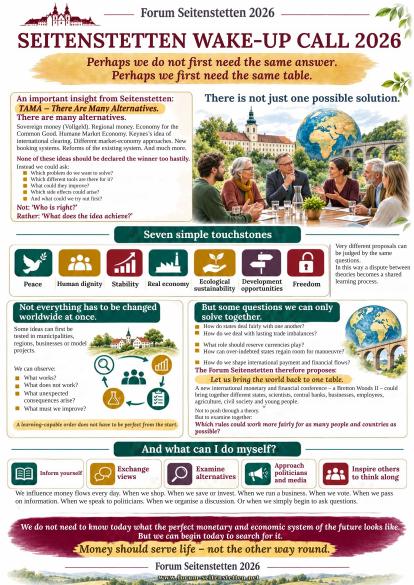
To act, we do not have to agree on a single theory of money first. We start by asking: which problem do we want to solve? Where in the monetary system is there a possible lever? Which tools exist, what might they achieve, what side effects are possible? To this end the Manifesto breaks the monetary system down into money creation, financing and distribution, money administration and payments, preserving value, use of money and international exchange – plus a seventh, overarching task: learning and improving. (Manifesto pp. 4–7)
🔎 Where does each reform idea appear?
The Manifesto and the Dossier declare no winners – they name and explain many approaches. The table shows where the ideas of cibwal.com appear in them (explained = treated in detail, named = explicitly mentioned, in substance = addressed in substance). A click opens the respective PDF page.
| Reform idea | Where to find it |
|---|
Humane Market Economy / RICH
→ Concept page | - Dossier p. 10 explained Chapter 16 “The Humane Market Economy” (Haisenko / von Brunn): flowing money, a separate store of value, secured basic income, interest and compound interest – with an appreciation of the design’s strengths.
- Manifesto p. 6 named One of the models the Manifesto explicitly names for examination (“Humane Market Economy”).
- Wake-Up Call p. 1 named Named among the reform approaches on the Wake-Up Call poster.
- Dossier p. 25 named Conclusions: “The Humane Market Economy asks: which functions should money fulfil in the first place?”
- Dossier p. 15 in substance Chapter 22: medium of exchange, unit of account, store of value and value preservation for savings and pensions (target vision 4).
|
INWO – flowing money (Gesell)
→ Concept page | - Dossier p. 12 explained “Gesell / currency-secured money models”: the question whether liquidity should be kept in circulation more strongly through holding costs – “What would be the consequences of systematic circulation security?”
- Dossier p. 10 named Flowing money as a building block of the Humane Market Economy.
- Dossier p. 15 in substance Chapter 22: preserving the value of savings – open to different ways of securing value.
- Manifesto p. 5 in substance Impact map, target vision 4 “Purchasing power and pensions”: price stability, store-of-value models, alternative monetary systems.
|
Hayek+ / currency competition
→ Concept page | - Dossier p. 11 explained Chapter 18 “Austrian School”: decentralised information, entrepreneurship, prices – “Which decisions can be taken better in a decentralised way?”
- Manifesto p. 6 named List of models to examine: “Austrian School and currency competition”; also target vision 11 “Democracy in money” (currency competition, complementary currencies).
- Dossier p. 12 in substance Regional and complementary currencies: “Can they strengthen regional resilience?”
- Dossier p. 1 named “Keynes versus Hayek” – the Dossier deliberately does not declare winners.
|
Keynes+ / sovereign money / state money
→ Concept page | - Manifesto p. 5 explained Impact map, target vision 5: “Keynes’ International Clearing Union with Bancor”, neutral clearing systems, Special Drawing Rights; target vision 7: sovereign money (Vollgeld), public and regional money creation.
- Dossier p. 7 explained Chapter 10 “Keynes – International Clearing Union and Bancor” and chapter 11 “Triffin’s dilemma”.
- Dossier p. 6 explained Chapter 8 “Sovereign money (Vollgeld) – idea and counter-arguments”.
- Dossier p. 5 explained Chapter 6 “Delegation 5” (sovereign money, public money creation, clearing after Keynes/Bancor) and chapter 7 “How money is created today”.
- Dossier p. 11 explained Chapter 18: Keynesianism, Post-Keynesianism, monetarism and Modern Monetary Theory (MMT).
- Manifesto p. 6 named List of models: “Keynes’ International Clearing Union with Bancor”, “Sovereign money”, “Post-Keynesian and MMT approaches”.
- Wake-Up Call p. 1 named Wake-Up Call: sovereign money and Keynes’s idea of international clearing.
- Dossier p. 24 named Source core: Bank of England, Swiss National Bank, IMF (Keynes Plan, Special Drawing Rights).
|
Social threefolding (S3F)
→ Concept page | - Dossier p. 12 explained “Social threefolding”: free cultural life, democratic legal life, cooperative economic life – several elements appear in the twelve target areas.
- Dossier p. 26 in substance Closing chapter: “How do we prevent economic power from automatically becoming political or cultural power?”
- Manifesto p. 6 named List of models: “Social threefolding”.
- Manifesto p. 1 in substance Target vision 1 “Power, wealth and debt”: democracy and economic power in balance.
|
Commodity Money+
→ Concept page | - Manifesto p. 6 named List of models: “Commodity-money and real-value approaches”.
- Dossier p. 15 in substance Chapter 22: store-of-value models, bonds, real assets and forms of money as open fields of inquiry.
- Dossier p. 17 in substance Chapter 24.1: raw materials and indispensable knowledge – fair access with fair remuneration.
- Manifesto p. 2 in substance Target vision 2 “Raw materials and indispensable knowledge” and target vision 4 “Purchasing power, savings and pensions”.
|
Value Money+ / booking systems
→ Concept page | - Dossier p. 12 explained Gemeinwohlzukunft booking system (GWZ-BS): “From monetary value to goods-and-services value” – a transparent booking system.
- Manifesto p. 6 named List of models: “GWZ booking system”.
- Dossier p. 5 named Digital numerical bookkeeping as an indicator of value; money as a value-payment medium.
- Dossier p. 15 in substance Chapter 22: medium of exchange, unit of account and store of value as separate functions of money.
- Manifesto p. 3 in substance Target vision 10 “Prosperity is more than money”: money as a tool for exchanging, coordinating and recording.
|
The documents were produced by the Forum Seitenstetten (forum-seitenstetten.net); the English version is a translation. The comic’s illustrations are AI-generated.
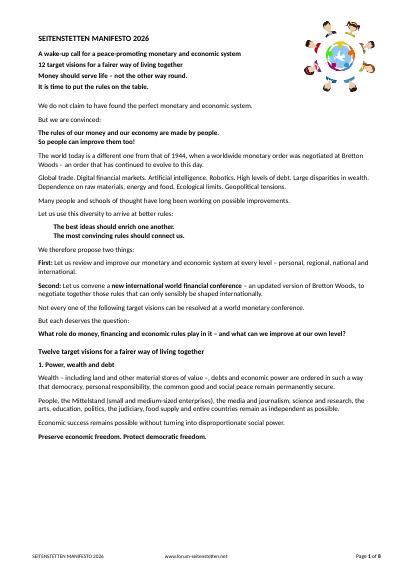 Manifesto (8 pp.)The twelve target visions, TAMA, impact map, touchstones, Bretton Woods II.Open PDF (EN)
 Comic (32 pp.)“The World at One Table” – 12 questions, many possible answers.Open PDF (EN)
 Sources & Background Dossier (27 pp.)Technical background, test criteria and sources for all twelve topic areas.Open PDF (EN)